Aviation fuel storage demands the highest levels of engineering precision, contamination control, and risk management. Jet fuel (Jet A-1) and avgas are volatile, flammable hydrocarbons that power commercial, military, and general aviation aircraft. Any compromise in storage quality can lead to engine failure, operational disruptions, or catastrophic safety incidents. At Shamrock Engineered Solutions, we bring extensive expertise in oil & fuel storage tanks to help airports, fuel terminals, and aviation facilities design, install, maintain, and inspect systems that meet stringent international standards while ensuring long-term reliability and compliance.
Our turnkey design-and-build capabilities, combined with specialist inspection to EEMUA 159 and related standards, make us a trusted partner for critical fuel infrastructure in the oil & gas and fuel sectors.
Why Aviation Fuel Storage Requires Specialised Solutions
Aviation fuel is far more sensitive than standard petroleum products. It must remain free from water, particulates, microbial contamination, and other impurities that could cause filter blockages or corrosion in aircraft systems. Storage tanks must prevent evaporation losses, static electricity build-up, and fire/explosion risks in environments where aircraft operate continuously.
Key challenges include:
- Maintaining fuel cleanliness to strict filtration and quality standards
- Managing thermal expansion, vapour pressure, and breathing losses
- Providing robust secondary containment for environmental protection
- Integrating with high-flow fuelling systems, hydrant networks, and filtration equipment
- Ensuring compliance with aviation-specific regulations alongside general hazardous substances rules such as COMAH and DSEAR
Shamrock supports clients across fuel distribution and high-risk facilities with tailored solutions for above-ground welded or bolted steel tanks, specialist linings, and integrated safety systems.
Material Selection and Tank Design Considerations
Aviation fuel storage tanks are typically constructed from carbon steel or stainless steel, selected for compatibility with jet fuel chemistry and resistance to corrosion. Internal coatings or linings must be approved for aviation fuel service to prevent leaching or degradation that could contaminate the product.
Design features commonly incorporated include:
- Floating roofs or fixed roofs with internal floating covers to minimise vapour space and reduce evaporation and oxidation
- Sloped floors with water draw-off sumps for easy removal of any accumulated water
- Advanced venting systems with pressure/vacuum relief valves to handle thermal breathing while preventing over-pressurisation
- Filtration and water separation integration points for downstream fuel conditioning
- Cathodic protection and high-performance external coatings for long-term corrosion resistance, particularly important for tanks in coastal or humid airport environments
For new installations or upgrades, Shamrock provides value engineering during the design phase. We assess site-specific factors such as wind loading, seismic activity, and proximity to aircraft movements to optimise tank geometry, foundation design, and bunding.
Bolted steel sectional tanks offer advantages in certain scenarios for faster erection with minimal hot work, while traditional welded tanks provide maximum integrity for large-volume storage at major airports.
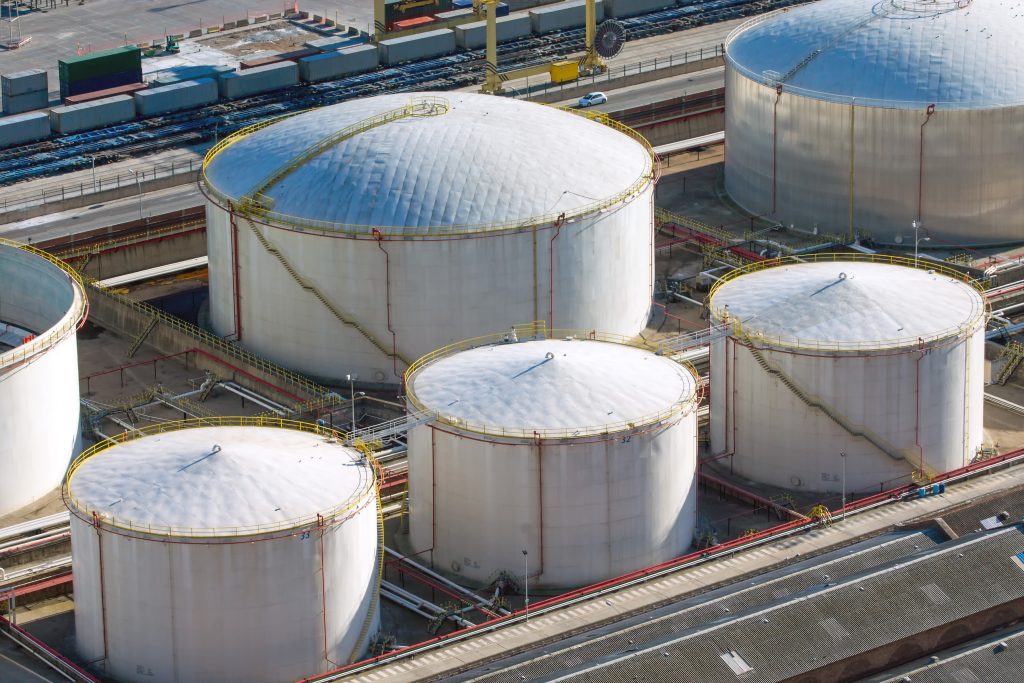
Secondary Containment and Environmental Protection
Spill prevention is non-negotiable for aviation fuel. Tanks must sit within robust bunds or secondary containment systems capable of holding 110% or more of the tank’s capacity, depending on local regulations. Bund floors and walls require impermeable liners or specialist concrete treatments to prevent fuel migration into soil or groundwater.
Modern approaches to base construction focus on preventing cracking and leaks through flexible membrane systems, high-quality joint sealing, and careful attention to settlement. Shamrock’s expertise in storage tank base design helps clients avoid common failure modes that could lead to costly environmental incidents or regulatory breaches.
Drainage systems within the bund must allow safe removal of rainwater while retaining any fuel spills, often incorporating oil-water separators and automatic shut-off valves.
Fire and Explosion Protection
Aviation fuel’s low flash point makes fire safety paramount. Design and safety requirements typically include:
- Fire-resistant or fireproof tank supports and separation distances from buildings, aircraft, and other tanks as per relevant codes
- Foam injection systems or fixed fire suppression connected to the tank roof or bund areas
- Lightning protection and comprehensive earthing/bonding to dissipate static charges generated during filling or pumping
- Emergency shutdown systems integrated with site-wide fire detection
- ATEX-rated electrical equipment in hazardous zones around the tank farm
Shamrock coordinates mechanical, civil, and electrical works to ensure these safety features function as an integrated system. Our project management experience ensures seamless installation without compromising ongoing airport operations.
Inspection, Maintenance, and Integrity Management
Regular inspection is critical for aviation fuel tanks due to the severe consequences of failure. Shamrock performs comprehensive tank assessments in accordance with EEMUA 159, the leading UK and European guidance for above-ground flat-bottomed steel storage tanks. This includes visual inspections, ultrasonic thickness measurements, non-destructive testing (NDT), and evaluation of welds, floors, and roofs.
Additional aviation-focused checks often cover:
- Internal cleanliness and coating condition
- Sump and draw-off system functionality
- Floating roof seal integrity (where fitted)
- Corrosion under insulation (CUI) on associated piping
- Foundation settlement monitoring
Our maintenance and repair services help clients decide when to repair versus replace ageing tanks, minimising downtime during critical outage windows. Techniques include specialist cleaning, recoating with aviation-approved materials, and targeted repairs to extend asset life while maintaining fuel quality.
We also support ongoing compliance through tailored inspection schedules that balance regulatory requirements with operational needs, reducing unnecessary disruption at busy fuel terminals.

Integration with Fuelling Infrastructure
Aviation storage tanks rarely operate in isolation. They form part of a broader system including:
- Pipeline or road tanker receipt facilities
- High-capacity pumps and metering skids
- Multi-stage filtration and water removal units
- Into-plane fuelling hydrant systems or bowser loading points
- Quality control laboratories and sampling points
Shamrock’s multi-disciplinary project management ensures perfect coordination between civil foundations, mechanical tank and piping installation, and electrical instrumentation and controls. This integrated approach delivers fully commissioned systems ready for safe, efficient operation.
Regulatory and Standards Framework
Aviation fuel storage must satisfy a layered set of standards, including:
- NFPA 407: Standard for Aircraft Fuel Servicing
- NFPA 30: Flammable and Combustible Liquids Code
- API 650 / 653: Welded tanks for oil storage and tank inspection/repair
- EEMUA 159: Inspection, maintenance, and repair guidance
- UK-specific requirements under the Control of Major Accident Hazards (COMAH) regulations for larger installations
- Civil Aviation Authority (CAA) and airport authority guidelines
- Environmental permitting and spill prevention regulations
Shamrock stays current with evolving standards and provides regulatory guidance as part of our consultancy services, helping clients navigate approvals for new builds, modifications, or life-extension projects.
Benefits of Partnering with Shamrock for Aviation Fuel Storage
Choosing a single experienced supplier for aviation fuel tank projects delivers clear advantages:
- Reduced interface risks through coordinated civil, mechanical, and electrical delivery
- Optimised designs that balance safety, operability, and whole-life costs
- Expert inspection and maintenance that extends asset life and protects fuel quality
- Minimal operational disruption thanks to careful planning and rapid response capabilities
- Full traceability and documentation for audit and insurance purposes
Our work across fuel storage terminals and high-risk facilities equips us to handle the unique demands of aviation environments, from remote airfields to major international hubs.
Whether you require a new storage tank installation, upgrade of existing infrastructure, detailed integrity assessment, or ongoing maintenance support, Shamrock Engineered Solutions provides reliable, compliant solutions tailored to the aviation sector.
Storage tanks for aviation fuel must exceed standard industrial requirements in design robustness, contamination control, and safety integration. From specialist material selection and floating roof systems to comprehensive fire protection and rigorous inspection regimes, every element plays a vital role in protecting lives, assets, and the environment.
Shamrock Engineered Solutions combines deep fuel storage expertise with end-to-end project capabilities to deliver storage systems that operators can trust. Our commitment to EEMUA 159-compliant inspection, turnkey construction, and proactive maintenance helps aviation clients maintain the highest standards of fuel quality and operational safety.
Contact Shamrock Engineered Solutions today on +44 151 319 7265 or at info@shamrockgroup.org to discuss your aviation fuel storage requirements. Let our team provide a free initial scope review and demonstrate how we can support your critical infrastructure needs.